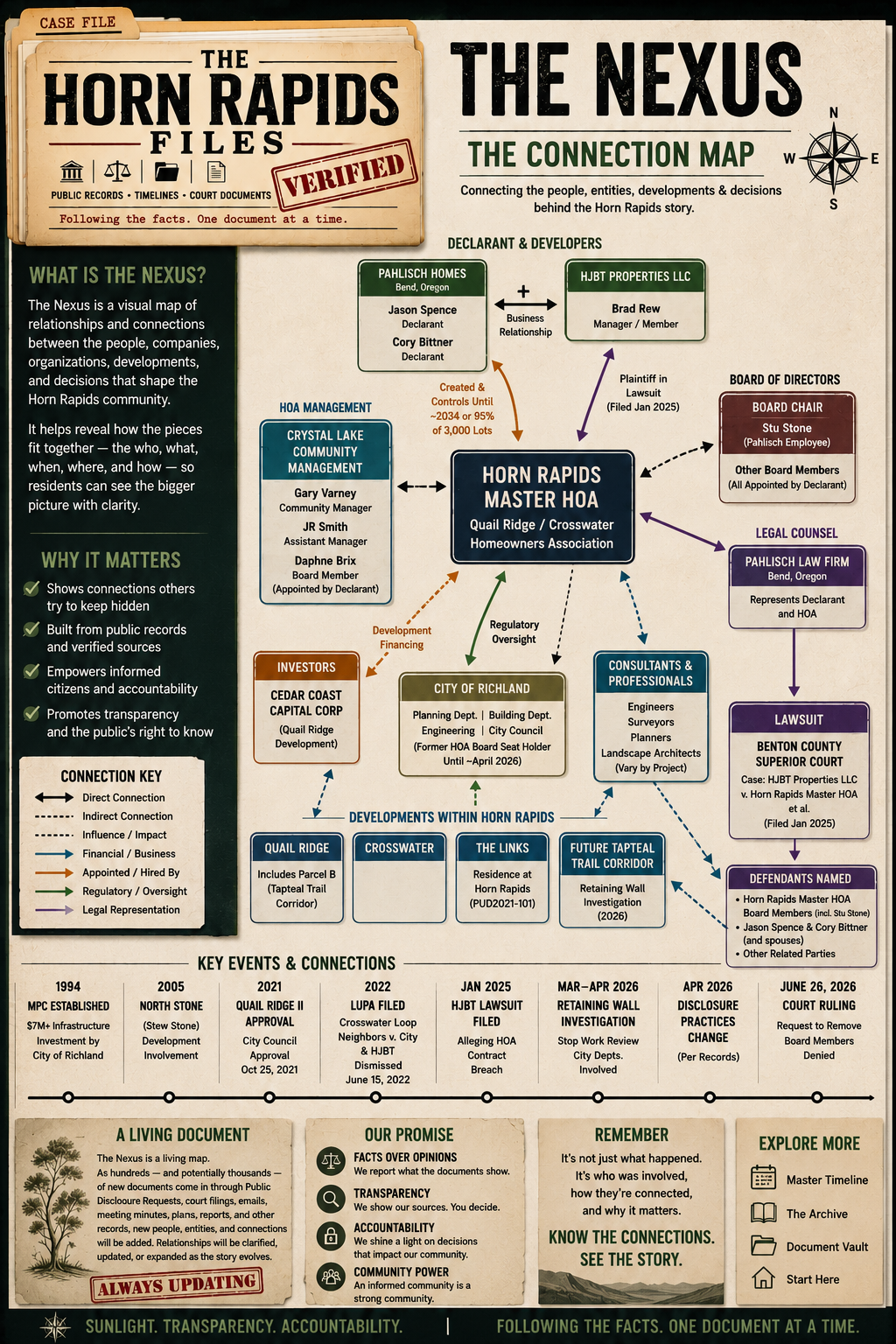
The Nexus Connection Map
What Is the Nexus?
Think of The Nexus as a giant "who's who" and "who's connected to who" map.
When you're reading public records, names start appearing over and over again. At first, they're just names on paper. But as more documents arrive, you begin to see how people, companies, government agencies, neighborhoods, projects, and decisions connect to one another.
The Nexus helps organize those connections in one place.
It's not about suggesting wrongdoing or drawing conclusions. It's about helping readers understand who is involved, what role they played, and how different people or organizations appear throughout the public record.
Sometimes a single email doesn't mean much.
But when you discover the same person appears in planning documents, meeting minutes, emails, court filings, and development records over several years, the bigger picture begins to emerge.
The Nexus makes those relationships easier to understand.
Why Is It Important?
Imagine opening a 2,000-piece jigsaw puzzle without looking at the picture on the box.
Every piece is real.
Every piece matters.
But until you start connecting them, it's almost impossible to understand what you're looking at.
That's what The Nexus does.
It helps connect the pieces.
Understanding who's who is often just as important as understanding what happened, because people don't work in isolation. Projects involve developers, engineers, city staff, elected officials, attorneys, contractors, consultants, HOA board members, homeowners, and many others.
Knowing each person's role provides context for the documents you're reading.
A Living Document
The Nexus is a living document.
As hundreds—and eventually thousands—of public records, court filings, emails, maps, meeting minutes, and planning documents continue to arrive, new people, organizations, and relationships will be added.
Some connections will become stronger as additional records confirm them.
Others may be updated, clarified, or even removed if new information changes our understanding.
The goal isn't to create a static chart.
The goal is to build an evolving reference that grows with the public record and helps readers navigate an increasingly complex story.
The Horn Rapids Files Promise
The Nexus is built from documented information—not assumptions.
Whenever possible, every connection is supported by public records, court filings, or other reliable sources. As new records become available, the map will continue to evolve.
Because understanding who is involved is often the first step toward understanding what happened.
Transparency & Sources
The Horn Rapids Files is an independent reference archive built from public records obtained through lawful Public Records Requests, court filings, and other publicly available sources.
Each summary is written in plain English to help readers better understand complex documents and government processes. Whenever practical, the original records are made available so readers can review the source material for themselves.
The purpose of this archive is to organize information—not replace the original documents—and to present that information as accurately and transparently as possible.